
01 — Anglo-Saxon fabric
Look for surviving pre-Conquest masonry within the church. Architectural evidence places the earliest surviving fabric in the Anglo-Saxon period, probably the 8th or early 9th century.
Visit & Heritage
Explore more than a thousand years of Christian worship, medieval craftsmanship and the story of the Neville and Vane families at St Mary’s, Staindrop.
Begin in the nave
St Mary’s rewards a slow visit. The present building contains fabric from before the Norman Conquest alongside Norman, medieval, post-Reformation and Victorian work. Look at the masonry, arches, windows and changes in level: they reveal a church that has grown and changed around a continuing place of worship.
The oldest features are not always the most spectacular. Some are small pieces of stonework or architectural details incorporated into later building phases, but they are among the most important evidence for the early Christian history of Staindrop.
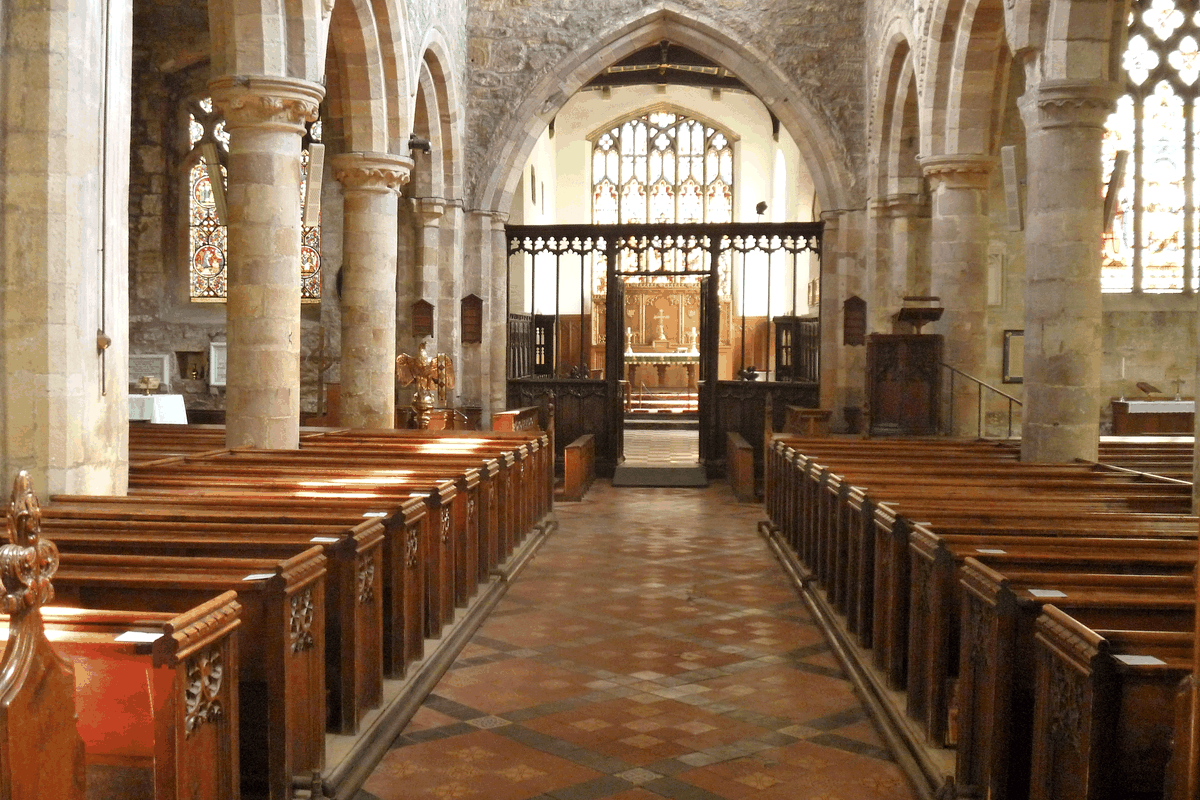
Look for surviving pre-Conquest masonry within the church. Architectural evidence places the earliest surviving fabric in the Anglo-Saxon period, probably the 8th or early 9th century.
An early sundial and fragments of Anglo-Saxon sculpture, including part of a ring-headed cross, connect the present church with worship here before the Norman Conquest.
The great rounded arches of the nave belong principally to the early 12th century. Their cylindrical piers and Romanesque character preserve the scale and rhythm of the Norman church.
Look for changes in stonework, blocked openings and old roof lines. These architectural scars show how the church was repeatedly enlarged and remodelled.
The medieval church
In the early 15th century St Mary’s became a collegiate church associated with Ralph Neville, 1st Earl of Westmorland. A body of priests served here, maintaining worship and chantry prayers. Important medieval fittings survive from the world in which that college functioned.

The surviving pre-Reformation screen marks the transition from the parish nave towards the chancel and gives a strong impression of the medieval organisation of the church.
The 15th-century stalls belong to St Mary’s collegiate period. Look closely at the carved details, poppyheads and the misericords beneath the hinged seats.
Three medieval stone seats on the south side of the chancel were used by clergy during the Eucharist. Their cusped heads and carved details survive as part of the medieval sanctuary.
Small medieval recesses and basins around the church reveal the practical life of worship: washing sacred vessels and storing liturgical objects.
The Nevilles of Raby
The Neville family of nearby Raby Castle transformed the status and character of St Mary’s. Their monuments make the church an exceptional place for understanding the family that became one of the dominant aristocratic powers of late-medieval England.
Please do not touch or lean on the monuments. Their stone, alabaster, timber and surviving surface detail are vulnerable to wear.
The alabaster monument of Ralph Neville, 1st Earl of Westmorland, who died in 1425, is one of the outstanding treasures of St Mary’s. It includes effigies associated with Ralph and his two wives.
The 14th-century monument to Euphemia de Clavering, who died in 1320, lies beneath an elaborate Gothic canopy and belongs to the generation before the great expansion of Neville patronage.
An earlier monument depicting a woman and a young boy survives in the south aisle. Its precise identity is less certain, adding to the fascination of this group of medieval memorials.
A remarkable later Neville chest tomb with carved effigies survives at the west end of the south aisle. Its darkened timber can easily be mistaken for stone at first glance.
Faith, family and memory
St Mary’s continued to serve the parish after the medieval college disappeared at the Reformation. Later memorials, furnishings and the continuing connection with Raby Castle add new layers to the story.
The octagonal font dates from the medieval period and carries heraldic decoration, including associations with the Nevilles. It is a powerful reminder of centuries of baptism in this church.
After the Neville era, the Vane family became closely associated with Raby Castle. Their monuments and memorials continue the long relationship between the castle, its families and the parish church.
A surviving post-Reformation altar table demonstrates that St Mary’s historic significance does not end with the Middle Ages; worship and furnishings continued to develop in later centuries.
Look up
Some of the church’s most rewarding details are above eye level. Allow your eyes time to adjust to the light and look carefully at the windows, roof and carved details.
The church contains important Victorian stained glass, including late-19th-century work associated with the Kempe tradition, as well as a small survival of medieval glass.
Look upwards in the choir and chancel for painted decoration and heraldic imagery. The roof is an important part of the visual story of the church and its patrons.
Before you leave
The exterior makes the long development of St Mary’s easier to understand. Different phases of sandstone masonry, medieval windows, buttresses and the west tower show that this is not a building created at a single moment.

Walk around the church to see the embattled tower, medieval windows, buttresses, gargoyles and the changing character of the stonework from one building phase to another.
Pause in the churchyard to appreciate the scale of the building and its place within Staindrop. The nearby presence of Raby Castle helps explain the extraordinary Neville and Vane story preserved inside.
A simple route
If this is your first visit, the following route takes you through the story in a natural order. There is no need to rush: St Mary’s is still a living church as well as an historic building, and you are welcome to stop, sit and be still.
St Mary’s is both a place of worship and a Grade I listed historic church. Please avoid touching fragile monuments, carved stone, historic timber and painted surfaces. Follow any conservation notices or temporary barriers in the church.
Interpretation is based on the best available published research and may be refined as scholarship develops. Above all, remember that the building remains a living Christian church serving the parish of Staindrop.
“Listen to Deacon Hugh” sends only the generated reply to ElevenLabs for speech. No microphone is used. AI may make mistakes; confirm important details with the parish.